

Anxiety treatment
When anxiety will not let go,
there are still options
Evidence-based help for anxiety in South Africa, including TMS for when therapy and medication have not given enough relief.
Anxiety treatment at a glance
- What is an anxiety disorder?
- A pattern in how the brain's threat, emotion and control networks communicate, so the alarm keeps sounding when there is no real danger.
- How is it treated?
- Usually with therapy such as cognitive behaviour therapy (CBT) and medication, supported by routine, sleep and movement.
- Can TMS help anxiety?
- TMS is not a standard first-line treatment for anxiety, but growing research suggests it may help some people when conventional treatment has not been enough or has not been tolerated.
- What about PTSD?
- A double-blind, placebo-controlled trial found TMS improved core PTSD symptoms more than sham. Guideline reviews rate it as probable efficacy.
- Do I need a referral?
- No. A Rewire psychiatrist will meet with you first to understand your situation, at our clinics in Cape Town and Gauteng.
Understanding it
Anxiety is more than worry
Everyone feels anxious at times. An anxiety disorder is different: the alarm keeps sounding when there is no fire, and it starts to shape how you live.
Anxiety disorders involve changes in the way the brain networks responsible for threat detection, emotion and cognitive control communicate with one another. The prefrontal cortex is one important part of these networks, and it works closely with deeper regions of the brain involved in fear and anxiety.
That is why anxiety is not a weakness or a failure of willpower. It is a pattern in how the brain is processing threat, and patterns in the brain can change with the right treatment. Anxiety also often travels with depression, and when the two occur together, treating both matters.

The options
How anxiety is treated
Most people are helped by a combination of approaches, tailored to the kind of anxiety they live with.
01
Therapy
Cognitive behaviour therapy (CBT) helps you notice and work with anxious thought patterns and the avoidance that keeps anxiety going, so that over time the alarm settles.
02
Medication
Several medications can reduce anxiety. Each person responds differently, and finding the right one, at the right dose, is a process to work through with your doctor.
03
Lifestyle
Steady routines, good sleep, regular movement and cutting back on alcohol and caffeine all calm the nervous system, and help other treatment work better.
04
Neuromodulation
When conventional treatment has not given enough relief, or has not been tolerated, TMS works directly on the brain networks involved in anxiety.
See where TMS fitsTargeting the networks
Where TMS fits in
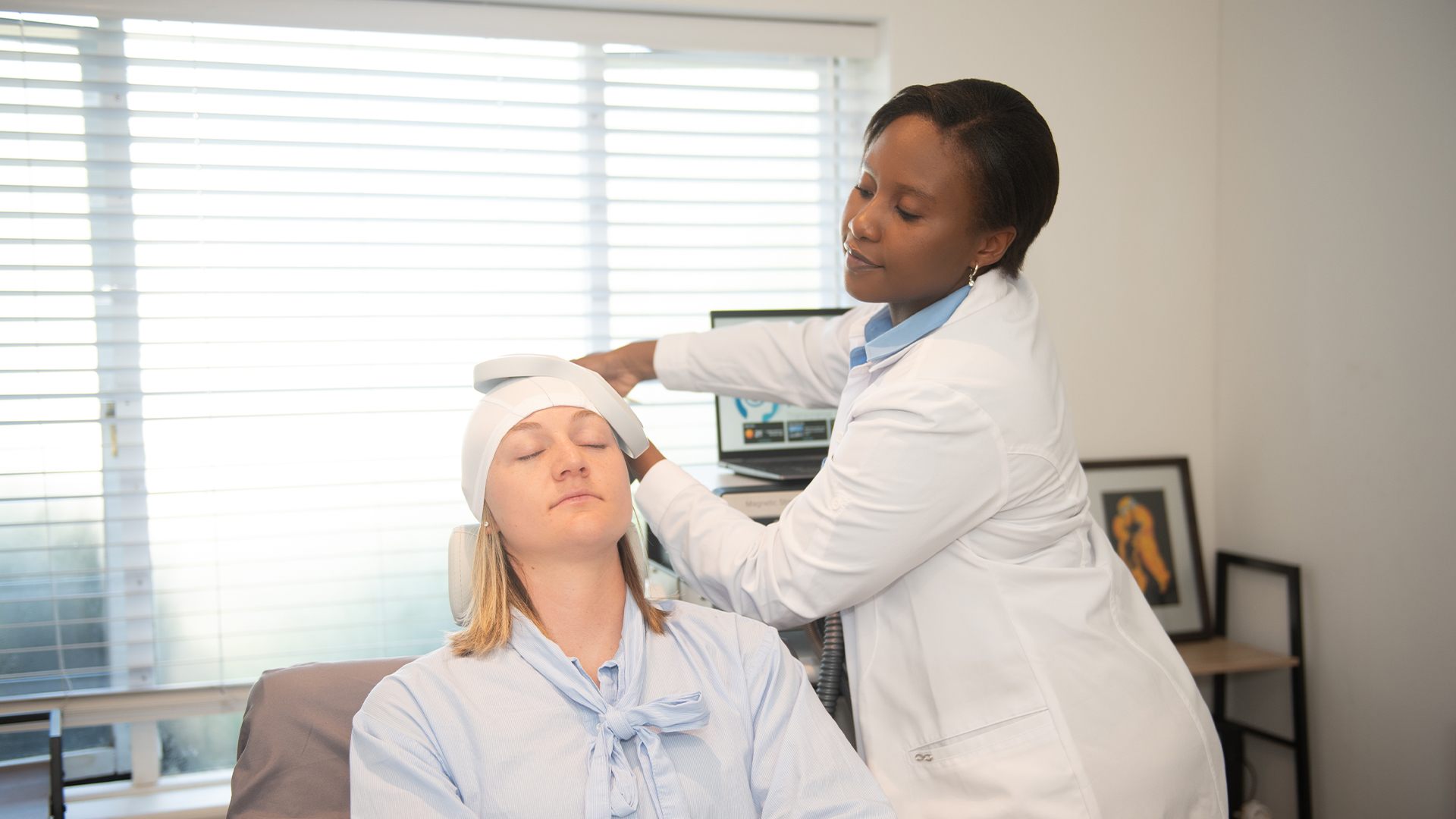
TMS (transcranial magnetic stimulation) uses magnetic pulses to influence activity within the brain networks involved in anxiety. Depending on the condition and treatment protocol, stimulation may be used to increase or decrease activity in a targeted region of the cortex, with effects that extend through the wider networks it is connected to.
TMS is not currently a standard first-line treatment for anxiety disorders. However, growing research suggests that it may help some people, particularly when conventional treatments have not provided sufficient relief or have not been well tolerated.
It is gentle and medication-free. You stay awake, there is no anaesthetic and no hospital stay, and you can drive yourself home afterwards. Every patient is assessed by a psychiatrist first, to make sure it is the right fit.
An honest look
What the evidence says
PTSD. A foundational double-blind, placebo-controlled trial found that high-frequency TMS over the right prefrontal cortex improved core PTSD symptoms, such as re-experiencing and avoidance, more than slow-frequency or sham stimulation. Guideline reviews rate this as probable efficacy: supportive, but not yet definitive.
Generalised anxiety. Pooled data suggest a real symptom-reducing effect, but it rests on a small number of varied trials using different targets and frequencies. Protocols are not yet standardised, and larger studies are needed.
Anxious depression. TMS is cleared for anxiety symptoms that occur within a depressive episode. For a primary anxiety disorder on its own, it should be understood as an emerging, off-label option.
We would rather you hear this plainly from us. A psychiatrist will talk you through what the research means for your situation before any treatment is suggested.
Living with depression as well? Read about depression treatment
Sources
- Cohen H, et al. (2004). Repetitive TMS of the right dorsolateral prefrontal cortex in PTSD: a double-blind, placebo-controlled study. American Journal of Psychiatry.
- Lefaucheur JP, et al. Evidence-based guidelines on the therapeutic use of repetitive transcranial magnetic stimulation (rTMS).

If you need help right now
If you or someone you love is in crisis or thinking about suicide, please reach out now. You are not alone. Contact the SADAG 24-Hour Suicide Crisis Helpline on 0800 567 567 (free, 24 hours), or in an emergency call 10177 for an ambulance or 112 from any mobile.
Common questions
Anxiety and TMS, answered
Talk to someone who can help
No referral is needed. A Rewire psychiatrist will meet with you first to understand your situation and discuss the right path forward, at our clinics in Cape Town and Gauteng.